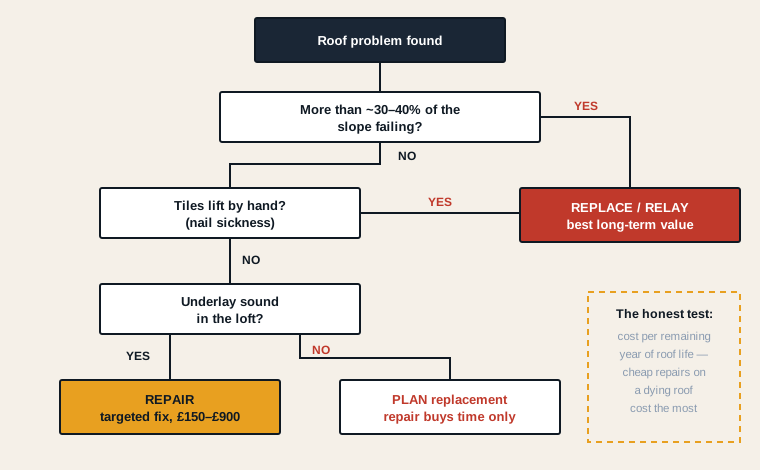
An honest Cambridge decision guide — when a repair is the smart choice, when a re-roof is better value, and when replacement is oversell.
Repair a Cambridge roof when the covering is sound and failure is localised; replace when tiles are slipping across the whole roof from nail sickness, the underlay has perished, or you are past repeated annual repairs. As a rule of thumb, once more than about a third of the roof has failed, replacement is better value. Call 0122 366 6465 for an honest survey.
This is the question every roofer should answer honestly and many do not — because a re-roof is a far bigger invoice than a repair. The right answer depends on three things: how much of the roof has actually failed, the condition of the fixings holding the covering on, and whether the underlay beneath is still doing its job. Get those three straight and the decision is usually clear.
The rule of thumb professionals use is the one-third test: once roughly 30–40% of the covering has failed, patching it tile-by-tile costs more over time than replacing it, because you are paying repeatedly for access to a roof that is going to need doing anyway. Below that, and where the underlay is sound, a targeted repair is the sensible, cheaper choice.
Repair is the honest recommendation when the failure is localised and the rest of the roof has life left. A handful of slipped or cracked tiles after a storm, a single failed lead valley, a cracked chimney flashing, or a discrete leak traced to one junction — these are repairs, not re-roofs, and anyone telling you otherwise is overselling.
On Cambridge's 1930s Chesterton semis and post-war Arbury estate roofs, a concrete-tile covering that is largely sound but has lost a few tiles is a classic repair case. The covering has decades left; you fix what has failed and leave the rest. A repair here runs from £150 to a few hundred pounds and buys many more years.
Replacement becomes the better-value choice when the failure is systemic rather than local. The clearest sign is nail sickness — tiles or slates slipping across the whole roof because the fixing nails have rusted through. You see it constantly on Cambridge's Victorian slate terraces around Petersfield and Romsey Town: the slate itself is often fine, but the iron nails have corroded, so slates let go one after another. Patching that is money into a bottomless pit; a strip-and-relay refixes the sound slate with new copper or stainless nails and gives you another lifetime.
The other replacement triggers are a perished underlay (once the felt beneath has gone brittle, water gets past every repair), a visibly sagging roofline suggesting structural movement, and the simple economics of repeated call-outs — if you have paid for the same roof three times in a couple of years, you have already started paying for a new one in instalments.
Cambridge's roofs behave differently by era, and that shapes the repair-or-replace call. Knowing what is typical for your kind of property helps you sense-check any recommendation you are given.
| Property era | Typical covering | Usual verdict |
|---|---|---|
| Victorian terrace (Petersfield, Romsey Town) | Welsh slate on iron nails | Slate often reusable — strip-and-relay beats patching once nail sickness sets in |
| 1930s semi (Chesterton) | Clay peg or interlocking tile | Usually repairable well into old age; watch mortar-bedded ridges |
| Post-war estate (Arbury, King’s Hedges) | Concrete interlocking tile | Repairable until surface wear and moss are widespread, then replace |
| Modern (Eddington, Trumpington Meadows) | Modern tile / membrane | Almost always repair — these roofs are young; failures are usually detailing, not the covering |
These are starting expectations, not verdicts — only a survey of your actual roof and loft settles it. But if someone quotes a full re-roof on a modern Eddington house or a sound 1930s Chesterton semi, the era alone is reason to get a second opinion.
Historic England and the SPAB both advocate repair and reuse of sound historic materials over wholesale replacement — well-aged Welsh slate typically outlives its fixings, so 70–85% of a slate roof can often be relaid rather than renewed.
Source: Historic England / SPAB conservation guidance
The single most useful way to decide is to think in cost per remaining year of roof life, not headline price. A £300 repair on a roof with fifteen good years left costs £20 a year. The same £300 repair on a dying roof that will need replacing next winter costs £300 a year — and you still have to pay for the re-roof. Cheap repairs on a spent roof are the most expensive option there is.
A re-roof on a Cambridge semi runs roughly £5,500–£9,000 depending on material and access, and lasts 40–60 years when specified to BS 5534. Spread across that lifespan it is often the cheaper choice per year than propping up a failing roof — but only once the roof has genuinely reached that point. Before it has, replacement is oversell. We will tell you honestly which side of the line your roof sits on.
Because a re-roof is worth so much more than a repair, it is the classic upsell. A few honest checks protect you. Ask to see the evidence: a roofer recommending replacement should be able to show you photographs of widespread failure — slipped tiles across the whole roof, perished underlay, corroded nails — not just assert it. If the ‘evidence’ is a single leak or a couple of slipped tiles, you need a repair.
Be wary of pressure and vagueness: a quote with no breakdown, a ‘today only’ discount, or a refusal to consider a repair are all warning signs. A trustworthy roofer will happily explain why repair will not work in your specific case, in plain terms, and will put the reasoning in writing. If in doubt, get a second survey — a genuine re-roof case will be confirmed by two independent roofers; an oversell often will not.
Once roughly 30–40% of the roof covering has failed, repairing tile-by-tile costs more over time than replacing, because you keep paying for access to a roof that needs doing anyway. Below that, repair is usually better value.
It is when the iron nails fixing tiles or slates rust through, so the covering slips across the whole roof even though the tiles or slates themselves may be sound. It is the classic sign a Victorian slate roof needs relaying rather than patching.
Usually, yes — well-aged Welsh slate often outlives its fixings, so 70–85% of a sound slate roof can be relaid with new copper or stainless nails in a strip-and-relay.
Yes. If the covering is sound and only a localised area has failed, a repair is far cheaper and buys many years. We will tell you honestly when replacement is not needed.
A re-roof specified to BS 5534 typically lasts 40–60 years, making it a once-in-a-generation investment rather than a recurring cost.
Roughly £5,500–£9,000 for a semi depending on material and access; natural slate on a Victorian terrace runs higher. We quote every job after a free survey.
We survey the roof and the loft, check the extent of failure, the fixings and the underlay, and give you an honest recommendation with cost-per-year reasoning either way.
Book a free, honest survey. We will tell you straight whether a repair will do or a replacement is the better investment.
📞 0122 366 6465Last updated: August 2026