Cambridge's historic buildings demand roofing carried out with the right materials, methods and permissions. We specialise in heritage roofing across the city's conservation areas and listed buildings — natural slate, clay peg tile, lime mortar and traditional leadwork — working with the conservation team where consent is required.
Tell us the job in 30 seconds. No pushy sales, no call-out fee.
📞 Call Now: 0122 366 6465Heritage roofing in Cambridge covers listed buildings and conservation areas using traditional materials — natural Welsh slate, clay peg tile, lime mortar and hand-dressed leadwork. Work is priced per specification after survey, and we liaise with Cambridge City Council's conservation team and obtain listed building consent where needed. Call 0122 366 6465.
Heritage roofing is defined by constraint: the right materials, the right techniques, and the right permissions. On Cambridge's historic buildings, a roof must be repaired or renewed in a way that respects the building's age and satisfies the planning authority.
Cambridge's historic roofscape is built from natural Welsh slate, clay peg and plain tiles, and hand-made materials that modern mass-produced products cannot simply replace. On a listed building or in a conservation area, the local authority will normally require like-for-like materials — reclaimed or matched natural slate, matching clay tiles, and lime mortar rather than cement.
We source reclaimed and matched materials specifically for heritage work, so a repair or re-roof sits invisibly alongside the original and satisfies the conservation requirements.
Heritage roofs were built by hand and must be repaired by hand. That means bedding ridges and verges in lime mortar, hand-sorting and gauging slates, using traditional fixings, and detailing lead by hand rather than reaching for modern shortcuts. Cement mortar, mismatched machine-made tiles and synthetic substitutes all damage a historic roof and breach conservation requirements.
Our heritage work uses the methods the building was made with, because they are both the correct approach and, on the soft materials of period roofs, the approach that actually lasts.
On a listed building, almost any roof work needs listed building consent before it begins, and carrying out work without it is a criminal offence. In a conservation area, works are more tightly controlled and materials must preserve the area's character. We advise you at survey on what consent your project needs, and we liaise directly with Cambridge City Council's conservation officers to agree the specification.
Getting the permissions right protects you legally and ensures the work proceeds smoothly, without the risk of enforcement action or having to redo work in the correct materials.
Leadwork is at the heart of heritage roofing, and it is a craft in its own right. On Cambridge's historic buildings, hand-dressed lead is used for the details that keep a traditional roof watertight: the flashings where roof meets wall or chimney, the valley linings that carry water between roof slopes, the soakers and step flashings around stacks, and the lead-covered flat tops of bay windows and porches so common on the city's Victorian and Edwardian villas.
Lead has been the material of choice for these details for centuries because, properly installed, it lasts for generations — often outliving the covering around it. The key is correct-code lead, hand-dressed to shape and laid to the right dimensions with proper allowance for thermal movement. Lead that is too thin, or run in lengths that are too long, fails through fatigue cracking; we work to the traditional codes and bay sizes that give lead its long life.
Much of the leadwork we are called to on Cambridge heritage properties is the repair of earlier bad work — over-long runs of thin lead, or lead patched with sealant and modern substitutes that have failed. Replacing it correctly with hand-dressed, correct-code lead restores both the watertightness and the appearance the building deserves.
On listed buildings and in conservation areas, leadwork must be carried out to traditional standards to satisfy the conservation requirements, and substitute flashing materials are generally not acceptable. Our leadwork meets those standards, whether it is a single bay top on a Newnham villa or the full valley and flashing package on a listed Cambridge building.
Cambridge is among England's most historic cities, with Cambridge City Council designating eighteen conservation areas and the city holding an exceptional density of listed buildings. The Central Conservation Area covers the historic core and the colleges; the Mill Road, The Kite and New Town and Glisson Road areas protect the character of the city's Victorian neighbourhoods; and Riverside and Stourbridge Common, Brooklands Avenue, Newnham Croft, De Freville and West Cambridge each safeguard distinct historic areas. Roofing work in any of these must preserve the area's special character.
The dominant historic roofing materials vary across the city. The Victorian terraces of the Mill Road, Kite and New Town areas are predominantly natural Welsh slate, and re-roofing here almost always requires matching slate rather than a cheaper substitute. The older college and city-centre buildings within the Central Conservation Area carry clay peg tile, plain tile and, in places, stone and lead, all of which demand specialist heritage skills.
Beyond the city, the villages of South Cambridgeshire — many with their own conservation areas under South Cambridgeshire District Council — bring clay peg tile, thatch-adjacent detailing and soft handmade materials on properties where sympathetic roofing is essential.
For any heritage roof in Cambridge, the local planning authority is central. We understand what Cambridge City Council's conservation team expects, we know which materials satisfy each area's character, and we manage the consent process so your historic roof is repaired correctly, legally and to a standard that honours the building.
Historic England guidance on re-roofing traditional buildings stresses the use of matching natural materials and lime mortar over cement, and the Society for the Protection of Ancient Buildings (SPAB) advocates repair over replacement — principles that underpin conservation requirements on Cambridge's listed and historic roofs.
Source: Historic England / SPAB guidance
Historic or listed property in Cambridge? Get specialist heritage advice.
Call 0122 366 6465"Re-slated our listed house in the Kite in matching Welsh slate and dealt with the conservation consent. Faultless."
"Hand-dressed new lead valleys and bay tops on our Newnham Croft villa. Craftsmanship you rarely see now."
"Put right decades of bad cement repairs on our Mill Road conservation-area terrace with proper lime mortar."
Cambridge's Victorian terraces are largely Welsh slate. These signs mean the slate roof needs repair, matching or re-covering.
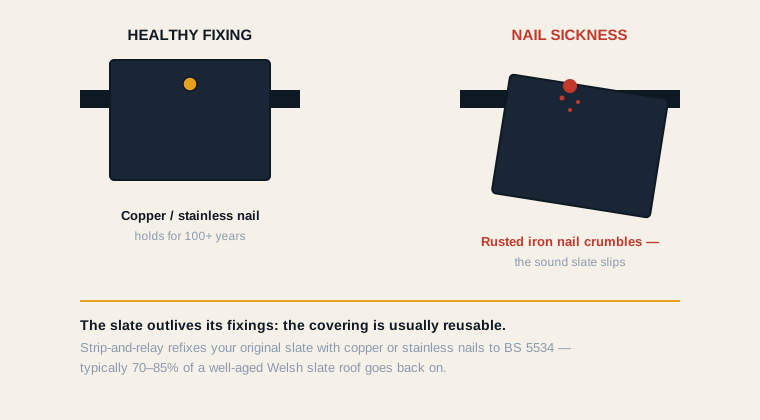
When it is not the answer: A well-aged Welsh slate roof is often reusable — 70–85% of the original slate can go back on in a strip-and-relay, so a full new-slate re-roof is rarely necessary if the slate itself is sound. Read the full guide.
Slate work on Cambridge's tall Victorian terraces needs a scaffold; we arrange and itemise it. Scaffold is specified for: strip-and-relay, valley work and any slate repair on a two- or three-storey terrace - always itemised in your written quote, never a hidden extra, and we arrange it.
Victorian terraces around Romsey Town and Petersfield mean rear access is tight and pavement scaffold often needs permit-controlled space. Pavement scaffold and skip permits go through Cambridge City Council; allow a few working days on streets like Mill Road, Gwydir Street, the terraces off Petersfield where space is tight.
Slate workmanship is guaranteed for 10 years; a relaid Welsh slate roof with new fixings can serve for another lifetime.
If a fault appears in covered work, we come back and put it right. No quibbling, no re-charge.
Historic England and the SPAB advocate repair and reuse of natural slate over wholesale replacement, since well-aged Welsh slate typically outlives its fixings — 70–85% of a sound slate roof can be relaid.
Source: Historic England / SPAB guidance
Yes. We specialise in listed building roofing across Cambridge using traditional materials and methods, and we obtain the listed building consent that almost all such work legally requires.
Cambridge conservation areas and listed buildings normally require matching natural materials — Welsh slate, clay peg tile, lime mortar and hand-dressed leadwork — rather than modern substitutes.
Often yes. Work in a Cambridge conservation area is tightly controlled and materials must preserve the area's character. Listed buildings almost always need listed building consent. We advise and liaise with the council.
Cambridge City Council has eighteen conservation areas, including the Central (Historic Core), Mill Road, The Kite, New Town and Glisson Road, Riverside, Brooklands Avenue, Newnham Croft and West Cambridge areas.
Yes. We hand-dress correct-code lead for flashings, valleys, soakers and bay tops on Cambridge heritage properties, to the traditional codes and bay sizes that give lead its long life.
Cement is harder than soft period materials and traps moisture, cracking brick and tile in frost. Lime mortar breathes and flexes, which is why it is required on Cambridge's historic roofs.
Heritage roofing in Cambridge is priced per specification after survey. Natural Welsh slate runs £180–£280 per square metre; leadwork and lime work are quoted per project.
Yes. We deal directly with Cambridge City Council's conservation team to agree the specification and secure any consent, so your heritage roof project proceeds correctly and legally.
Free surveys and written quotes across Cambridge and Cambridgeshire. No obligation, no pressure — just honest advice from a local roofer.
0122 366 6465