Repointing, lead flashing, chimney stack repairs and pot replacements across St Ives. We make your chimney weathertight and structurally safe.
Tell us the job in 30 seconds. No pushy sales, no call-out fee.
📞 Call Now: 0122 366 6465Chimney Repairs in St Ives covers damp patch on the chimney breast in an upstairs room and more, with clear written quotes and a 10-year workmanship guarantee. Prices start around £250. Call 0122 366 6465 for a free St Ives survey.
St Ives' Great Ouse location creates persistent humidity that accelerates lead corrosion on chimney flashings. Lead that would last 50+ years on a dry hillside may show signs of failure after 25–30 years in St Ives. We frequently replace flashings on the period properties around Market Hill and Bridge Street where the river damp has caused premature corrosion — often on the river-facing side of the stack only.
The historic town centre around Market Hill and Bridge Street includes period chimney stacks dating from the 17th century onwards. These tall, decorative stacks are fully exposed to weather and riverside damp. We use lime mortar for all period chimney work in St Ives, source matching bricks for stack repairs, and maintain original pot styles when replacements are needed.
Need a Roofer in Cambridge? Call Now for a Free Quote
0122 366 6465We inspect the chimney stack on your St Ives property — mortar condition on all four faces, lead flashing integrity, pot stability and brick condition. For the historic market town centre and 1930s-80s residential development across Market Hill, Bridge Street, Ramsey Road, The Waits and Needingworth Road, the mortar specification and failure patterns are well known to us.
We determine the correct mortar — lime for pre-1920 chimneys, cement for post-war stock. In St Ives, we recommend twice-yearly gutter cleaning, oversized drainage outlets on flat roofs, and EPDM for its superior moisture resistance near the river. We match the pointing profile to the existing work.
Mortar is raked to 15mm depth by hand, joints are cleaned and dampened, and new mortar is pressed in to the full depth. Lead flashings are cut and dressed into chased brickwork joints. For St Ives chimneys exposed to Great Ouse riverside humidity with moss growth rates 2-3 times faster than dry hillside locations, we pay particular attention to the windward face.
The completed chimney is checked from all angles. All work carries our 10-year guarantee. In St Ives's conditions, properly specified mortar should last 20-30 years before needing attention again.
"Lead flashing on the river side of the chimney had corroded through. They replaced it with heavier code 5 lead — should last longer in the damp conditions. Excellent work."
"Chimney repointed with lime mortar — the old cement pointing had cracked and was letting water through. Lime was definitely the right choice for this riverside property."
"Three pots needed replacing on our Victorian chimney. They sourced matching terracotta pots and re-bedded them properly. Stack looks just as it should — no shortcuts."
Chimney faults are a leading cause of damp in Cambridge's older homes. These signs mean the stack needs attention before the damage spreads inside.
When it is not the answer: Not every stained chimney breast is the stack itself — sometimes it is the flashing at the roof line. We trace the true cause before recommending work. Read the full guide.
Chimney work almost always needs a scaffold for safe standing time at the stack; we arrange and itemise it. Scaffold is specified for: almost all stack work — chimneys are the most exposed masonry and need safe standing time to work on properly - always itemised in your written quote, never a hidden extra, and we arrange it.
St Ives' historic riverside core has narrow lanes and listed stock that constrain access and materials. Pavement scaffold and skip permits go through Huntingdonshire District Council; allow a few working days on streets like The Waits, Crown Street, the riverside lanes where space is tight.
| Job | Typical range | Notes |
|---|---|---|
| Chimney flashing repair | £250 – £600 | Correct-code lead |
| Partial repointing (single face) | £150 – £400 | Weather face first |
| Full stack repointing (cement) | £300 – £600 | Modern stacks |
| Full stack repointing (lime, period) | £400 – £800+ | Period brickwork |
| Re-flaunching (bed pots) | £150 – £350 | Cracked flaunching |
| Cowl supply and fit (each) | £80 – £200 | Rain/downdraught/birds |
Worked example: Repointing the weather face of a Victorian stack on a Petersfield terrace in matched lime mortar, with scaffold, typically runs £400–£600. A full re-flaunch and repoint of a redundant Cherry Hinton stack is nearer £600–£900.
No deposit on repairs under £500. Larger stack work is staged after scaffold and materials are on site. VAT included.
Covering PE27 and surrounding postcodes.
Chimney workmanship is guaranteed for 10 years; we match mortar type and colour so the repair lasts and suits the stack.
If a fault appears in covered work, we come back and put it right. No quibbling, no re-charge.
Historic England recommends lime mortar for pre-1919 chimneys because it accommodates the movement and moisture of soft period brickwork — hard cement mortar on Cambridge's Victorian stacks commonly cracks and spalls the brick faces.
Source: Historic England repointing guidance
Chimney repointing in St Ives typically costs £250–£600. Period stacks in the town centre requiring lime mortar may be at the higher end. Scaffolding adds £200–£500 if needed.
The riverside humidity accelerates lead corrosion — particularly on the river-facing side of chimney stacks. Lead that would last 50+ years in a dry location may need replacement after 25–30 years near the Great Ouse.
Yes — on all period properties and many post-war properties too. Lime mortar handles the moisture cycling from riverside humidity better than cement-based products.
Yes. We rebuild partial and full chimney stacks using matching materials. For the historic town centre, we replicate the original brick bond and pointing profile.
If mortar is visibly crumbling or missing, we recommend not using an open fire until the chimney is repaired. Failed mortar can allow smoke and carbon monoxide to enter the property through gaps in the brickwork.
Yes. We fit cowls to prevent rain entry, birds nesting in the flue, and downdraught issues. We also fit capping plates on unused chimneys to seal them while maintaining ventilation.
Properly applied mortar lasts 20–30 years in typical conditions. In exposed locations or riverside settings, it may need attention sooner — 15–20 years. Lime mortar often outlasts cement on older chimneys.
St Ives' position on the Great Ouse creates the highest humidity of any town we cover — moss growth rates are 2–3 times faster than on dry hillside locations, and lead corrosion is measurably accelerated. For chimney repairs, this means riverside willows shed debris that blocks valleys and gutters throughout the growing season — not just autumn — creating a year-round maintenance demand unique to waterside properties.
The historic market town has period properties around Market Hill and Bridge Street, 1930s semis along Ramsey Road, and 1980s estates spreading east towards Needingworth — each era affected differently by the riverside damp.
We recommend twice-yearly gutter cleaning, fit oversized drainage outlets on all flat roofs, and specify EPDM over GRP for its superior moisture resistance near the river. St Ives is 15 miles north-west from our Cambridge base — close enough for same-day response on urgent work and regular maintenance visits.
The mortar specification is the most critical decision. For period chimneys across St Ives's older properties on Market Hill, Bridge Street, Ramsey Road, The Waits and Needingworth Road, we use NHL 3.5 hydraulic lime with sharp sand — sometimes adding brick dust to match the original pointing colour. For post-war chimneys, a 1:1:6 cement:lime:sand mix provides the right balance of strength and flexibility.
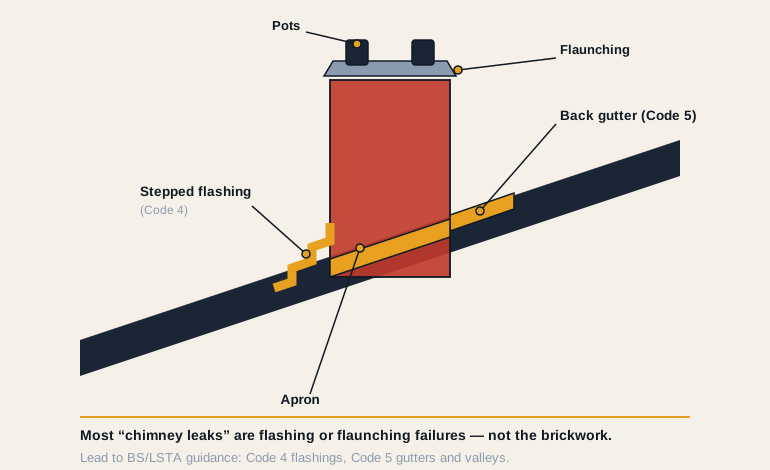
Chimney flashings in St Ives use code 5 lead (2.24mm) for aprons, back gutters and step flashings. The riverside humidity accelerates lead corrosion — we specify code 5 minimum where code 4 might suffice in drier locations. All lead is dressed into chase cuts in the brickwork and sealed with pointing mortar for a permanent, weathertight finish.
No call-out fees. No obligation. Just an honest quote from a local St Ives roofer who'll turn up when they say they will.
0122 366 6465